

Christian Counseling Blog
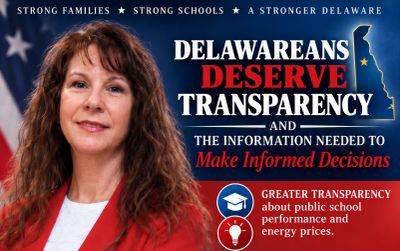
My Campaign Priorities
My name is Dr. Tanya Hettler, and I have been a Delaware resident for 32 years. I was born in the suburbs of Philadelphia and moved to Delaware with my husband in 1994 to pursue master's and doctoral degrees in clinical psychology at the University of Delaware. We originally planned to return to Pennsylvania after graduate school, but we fell in love with Delaware and decided to stay and raise our family here. We have two young adult children.
I worked as a clinical psychologist for five years before staying home to raise my son. When COVID-19 disrupted our children's education, I became actively involved in politics. In 2021, I ran for the Brandywine School Board because I wanted to help get our schools back on track.
I have been a Republican throughout my voting life, but I became actively involved in the Republican Party in 2021. I soon became particularly concerned about Delaware's poor educational performance. I was hired by the Caesar Rodney Institute to lead its Center for Education Policy, where I focused on improving educational outcomes and increasing educational options for Delaware families.
I have attended education meetings throughout the state, testified at legislative meetings, and worked with legislators on policies affecting Delaware families. I have advocated for evidence-based reading instruction, including phonics and the broader Science of Reading, greater school choice, and policies that focus on improving student outcomes rather than simply increasing spending.
The Caesar Rodney Institute has four public policy centers: Education, Economics, Energy and Environment, and Health Policy. I learned a considerable amount about each of these topics as they applied to Delaware.
I am now running to represent District 6 in the Delaware House of Representatives.
My Campaign Priorities
Our Schools
Delaware's public-school performance is a major concern. Even when using the significantly higher state-level testing results from the Delaware System of Student Assessment (DeSSA), the 2026 data show only 42 percent of students are proficient in English Language Arts and only 35 percent are proficient in math. (On the National Assessment of Educational Progress, DE students perform significantly lower. https://nces.ed.gov/nationsreportcard/subject/publications/stt2024/pdf/2024220DE4.pdf)
We need to be honest about these results. Simply spending more money is not the solution. Delaware must focus on the teaching that happens in the classroom and whether our investments actually improve student achievement.
Delaware has adopted several pieces of legislation requiring evidence-based reading instruction. One of these bills is SS1 for SB 4 which aligns the state's reading instruction and professional development with the Science of Reading. Unfortunately districts are not required to implement these requirements before the 2027–28 school year despite the fact that the law was passed in 2022. This has left 6 classes of students who were not effectively taught to read. This is horrible! I believe parents deserve transparency about how quickly (or slowly) their schools are preparing teachers and implementing these practices.
I will advocate for effective instruction, accountability, transparency, and greater educational options for families.
The Cost of Energy
Delaware families are also facing rising energy costs. We should examine the policies and regulations that affect those costs rather than placing all of the blame on utility companies.
Delaware participates in the Regional Greenhouse Gas Initiative (RGGI), a multistate program designed to reduce carbon dioxide emissions from fossil-fuel-fired power plants. This participation has led to the shutdown of power plants in our state. RGGI has also led to "greenhouse gas" penalties imposed on taxpayers by our legislators even though our state is already CO2 compliant. These fees could simply be removed by our legislators to save taxpayers money.
Delaware imports most of our energy from other states which has both increased the cost of our energy and increased emissions due to transporting the energy farther.
Delawareans deserve clear information about how our state policies affect electricity prices, reliability, taxes, and businesses. Before imposing additional energy mandates, we should understand their full costs and benefits.
A Government That Tells You the Truth
For more than 17 years, Delaware has been controlled by one political party. Long-term one-party control can reduce accountability and make it harder for voters to get the full picture on important issues.
Our state government should not limit citizens' access to important information about decisions affecting their health, families, and children. Delawareans deserve complete and accurate information so they can make informed decisions.
As your State Representative, I will work to make Delaware’s government more transparent, hold leaders accountable, and ensure that Delaware families have the information and options they need to make the decisions that are best for themselves and their children.
Inspirational Quotes
What is Socialism Really?
by Kimberly Strassel
Socialism has come in many forms through history and has seemingly infinite definitions. But simply put, it’s a system based on collective or government ownership of goods and services, as opposed to private ownership or markets. It’s animated by class warfare, the claim that the “workers” in a society are kept down and exploited by wealthy, powerful forces, and that only the forced seizure and redistribution of capital will produce a more egalitarian and just society.
Its other defining feature? It always fails, usually horrifically. Historians generally agree there have been more than two dozen major national attempts at socialism, all of which ended in tyranny and economic collapse. This dismal history has inspired advocates over the ages to produce new “versions” of socialism, ones they insist will finally produce magic. Karl Marx wrote off the earliest, failed communes as “utopian socialism” and contrasted it with his own “scientific socialism.”
Taken from "The Rise of Democratic Socialism" by Kimberly A. Strassel columnist for The Wall Street Journal
from Hillsdale College's Imprimis October 2026 | Volume 55, Issue 10

Bible Verse of the Month

1 Thessalonians 5:16-18 (NIV)
“Rejoice always, pray continually, give thanks in all circumstances; for this is God's will for you in Christ Jesus.”

Christian Counseling Blog
Welcome to Deep Thoughts With Doctor Tanya! My name is Dr. Tanya Hettler. I am glad you have found my counseling blog and podcas where you will read inspirational articles, motivational Bible verses and relevant quotes to help you face each day with a godly mindset.
Subscribe below to receive my free email newsletter!
The Photos on my Site
Most of the photos on Deep Thoughts with Dr. Tanya are of my plants and taken by myself. I hope you enjoy them!